APD has signed two contracts with Nokia to supply nitrogen to its Beijing and Dongguan plants in China for use in the company's electronics assembly and packaging process. Nokia has recently converted its printed circuit board assembly to a lead-free solder process, and nitrogen is needed in reflow soldering, a widely used method in surface mount technology (SMT) for packaging components on electronics printed circuit boards.
"It is an honor to be selected as Nokia's nitrogen supplier to their two plants in China. We have been working very closely with Nokia during its conversion process and supporting them in applying the technology to produce higher quality products with better environmental performance. These two contracts are significant for us. They demonstrate our technological capabilities to help customers in meeting their increasing requirements," said Saw Choon Seong, general manager of China Merchant Gases, Air Products.
"China is one of Nokia's biggest markets and an important technical, as well as manufacturing, base. When we were transforming to the lead-free solder process, we had high requirements from and expectations of our supplier. Air Products has shown its technological know-how and commitment during the whole process," said Xie Jiwei, Process Engineering Manager of Nokia Beijing, China.
APD serves customers in industrial, energy, technology and healthcare markets worldwide with a unique portfolio of atmospheric gases, process and specialty gases, performance materials, and equipment and services. Founded in 1940, Air Products has built leading positions in key growth markets such as semiconductor materials, refinery hydrogen, home healthcare services, natural gas liquefaction, and advanced coatings and adhesives. The company is recognized for its innovative culture, operational excellence and commitment to safety and the environment. Air Products has annual revenues of over $10 billion, operations in more than 40 countries, and 21,000 employees around the globe.
It said the fourth-quarter global phone market will be lower than the estimate of 330 million units it gave Nov. 14, when the company issued a profit warning. Nokia also said it now expects volumes to fall 5% or more next year from 2008 levels.
"2009 will be challenging for our industry, however we have a strong, enviable base to build on and I believe we will continue to strengthen our position on many fronts," Nokia Chief Executive Olli-Pekka Kallasvuo said in a statement ahead of the company's investor day in New York. Nokia said while it is committed to making investments for future growth, it plans to cut costs in 2009 and 2010. "Nokia's highly variable, low fixed cost business model allows us to scale to a declining market," said Rick Simonson, Nokia's chief financial officer. "We are also acting on all fronts to reduce our costs beyond what may be attributable solely to the scalable aspects of the business model -- moving to reduce cost of goods sold even further, reduce operational expenditure appropriately, and scale back capital expenditure. We expect these strong actions to offset, in part, the negative impact of slowing sales."
Fujitsu has launched what looks to be the world's first waterproof mobile phone, but the company is only claiming that it's the thinnest waterproof mobile phone. The F703i, which probably won't be making its way across the world from Japan to other markets, measures just 17.9mm thick and can apparently be submerged for half an hour.
It can only go down to a depth of 1 metre, but who's really going to go swimming with their mobile anyway?Features of the shiny-looking device include a 2.2-inch screen, a 1.3MP camera, and a webcam for video chatting. It also has a MicroSD slot for extra memory, although we can find nothing about a music player.
Today's Chinese handsets are covering most of the markets in Bangladesh. People are interested mostly because the Chinese mobile sets are very much cheap in Bangladesh. That's why the chinese handsets are getting popularity in banglaesh. Many people are using randomly these handsets. The user of this handsets are the poor and the lower middle class public. Because these handsets includes multimedia option. People can enjoy the facilities in a reasonable price. Not only in Bangladesh but also in many parts of the poor country in South Asia and Africa.
Most of the Chinese Mobile are the duplicate from many original handset as Nokia, Motorola, Sony Ericsson. These Chinese Mobile are using the name of them also as Nokla, Ndkia, Nckia, Sunnny Ericsson, Morotola, Nockla, etc.
But these handsets are not long lasting. There are many problems in Chinese Handsets. No warranty are given with them. So people are fade up with these chinese handsets. Day by day Chinese handsets are getting dispopularity in Bangladesh.
This week has been full of ups and downs as I have been fighting a cold or whatever crud I have. It makes me go from "full speed ahead" to feeling wiped out in a span of just minutes which makes working difficult. This week the tech news has been filled with the imminent arrival of the Blackberry Storm and one crossed the portal at Mobile Tech Manor for evaluation. This led to a 12 hour marathon review session that included shooting a couple of videos in addition to writing a quick review.
The creepy crud
I have been fighting this cold or sinus infection or whatever it is for a couple of weeks now and it's kicking my butt. It's one of those cruds that can have me feeling human and within 30 minutes feel totally wiped out and exhausted. Hopefully my body will start fighting back soon and kick this out of my system. It makes working difficult when you never know how you'll feel in advance.
Gadgetology
The main gadget in MTM this week is certainly the Blackberry Storm from Verizon. It's been dominating the tech news this week because let's face it, a Blackberry without a keyboard is breaking new ground. RIM compensates for the lack of a physical keypad or keyboard with the innovative SurePress on-screen keyboards and whether an individual will like it depends. On-screen keyboards are not as good as real ones but the key is if the on-screen keyboard is good enough for daily use. I have been using it for three days now and I am more than happy with the Storm keyboards. It's not as good as a real keyboard but miles ahead of every other on-screen keyboard that's come before.
Software time
The two utilities that have impacted my work for the better are simple ones each that do one thing and do it so well that they are a boon to my work. The first is the NumberKey for the iPhone which turns the phone into a wireless 10-key number pad. It wasn't free but I gladly paid the few dollars for it and I'm using this almost daily. I don't do so often but when I have to do a lot of number entry on the Macs I always really missed having a 10-key pad. NumberKey is not quite the real thing but I find entering numbers on the iPhone's screen to be better than using the number row on the keyboard.
eBook of the week
This week I have been enjoying a new author and it's been a good ride so far. The book is Precious Blood by Jonathon Hayes and it's about a serial killer. Bet you didn't see that coming. It's not as good as the Smoky Barrett series I've shared recently but it's not bad.
Going to bed now
I am winding down and getting very tired so I'm going to wrap this up. I hope you enjoy our visits and let me know if there's anything you'd like me to talk about during these weekly trips.
The firestorm that destroyed most of Oakridge Mobile Home Park in Sylmar has prompted investigations into whether tougher standards are needed to protect residents of manufactured housing in fire-prone areas.
Because many elderly people live in mobile home parks, state regulators and elected officials plan to explore the adequacy of evacuation plans and emergency procedures, which have been lacking at parks throughout the state.
State and county officials say they also will research policies on the spacing of mobile homes, the number of dwellings per acre, the removal of brush and flammable debris and the amount of flame- retardant building materials required in a mobile home.
Advocates for mobile home owners say that much needs to be done, from improving fire hydrants to better code enforcement by the state Department of Housing and Community Development, which regulates manufactured dwellings.
"This fire has brought a bright spotlight on manufactured housing because the state has put no care into the inspection and enforcement of health and safety measures," said Glenn Bell, president of Neighborhood Friends, a nonprofit advocate for mobile home owners.
Bell contends that the state has been slow to address complaints and inspect potential violations of health and safety codes. He said it took two years to get the state to investigate complaints of illegal wiring at the Blue Star mobile home park in Sylmar. The state eventually found problems throughout the 189-unit park.
Chris Anderson, a chief of field operations for the state housing department, disagreed with Bell. He said complicated cases can take time, that less serious violations don't require immediate correction, and that the department has been willing to grant extensions to park owners who are trying to make corrections.
Over 100 Million UMTS/HSPA Mobile Broadband Subscriptions Added Year-Over-Year
3G Americas, a wireless industry trade association representing the GSM family of technologies including LTE, today reports that 3G UMTS/HSPA mobile broadband technology continues its momentum throughout the world, adding more than 100 million subscriptions in the twelve months ending in the third quarter 2008 -- achieving a significant milestone in subscriber additions. At the end of third quarter 2008, global GSM/HSPA wireless subscriptions were nearly 3.4 billion adding 688 million new subscriptions for the GSM family of technologies in one year and capturing an 88.5% share of market, according to industry research firm, Informa Telecoms & Media.
In the Western Hemisphere, the number of GSM/HSPA subscriptions continued to grow at an explosive rate, having reached 499 million subscriptions at the end of the third quarter and then passing the half a billion milestone in October. CDMA technologies registered 463 million total subscriptions worldwide as of third quarter 2008, according to the CDMA Development Group. In comparison, there are more GSM/HSPA connections in the Americas region than CDMA narrowband connections worldwide. The GSM family of technologies represents 69% share of market in North, Central and South America, and registered annual growth of 115 million subscriptions at the end of September 2008, an annual growth rate of 30%. Informa forecasts more than 628 million GSM/HSPA subscriptions in the Americas region by the end of 2010.
GSM operators throughout the Americas region continue to evolve their networks to UMTS/HSPA.
"As evidenced by the subscriber growth numbers, the GSM family of technologies continues to provide the four key ingredients for mobile wireless success: Coverage, Technology Performance, Devices and Applications," stated Chris Pearson, President of 3G Americas. "The UMTS/HSPA mobile broadband technology achieved a total of 262 million subscriptions at the end of September 2008, continuing in its ranking as the leader in high speed mobile broadband technology worldwide."
Wireless technologies in Latin America continue to expand tremendously with a total of 378 million GSM/HSDPA subscriptions and 87% share of market. CDMA subscriptions continue to decline and totaled 45 million as of 3Q 2008, down from 56 million one year earlier and now representing only 10% share of market.
"It's remarkable what has occurred in the transition of the GSM family of technologies to mobile broadband in Latin America and the Caribbean in only ten years," commented Erasmo Rojas, Director of Latin America and the Caribbean. "In 1998, the first GSM network was deployed in the region, it took only five years before EDGE was commercially deployed in Chile in 2003, and three years later the first commercial UMTS/HSPA network was also deployed in Chile.
"Equally impressive is the uptake of 3G services throughout the region driven by the phenomenal success of the HSPA-enabled USB dongle as a competitive fixed broadband alternative, both on speed and price. In many cases, it is indeed the only available broadband connection," continued Rojas.
The AT&T 8525 is a feature-rich Windows Mobile Pocket PC providing access to your personal or corporate email, Internet, and your critical personal or business applications—all at broadband speeds. And with simultaneous voice and data functionality, you won’t miss a call when surfing the web or responding to email.
Music, messaging and a camera, of course, but also Windows Mobile 5 so you can cook up Word, Excel or PowerPoint files while on the go. With a large, high resolution touch screen and a slide out QWERTY keyboard, viewing work documents or playing games is a no-brainer. Use it to show presentations at a client meeting, and then to catch a movie on the plane home. Go ahead, create your own possibilities.
These features are available via a software upgrade free to all customers with Cingular 8525 / 8500 phones. Most AT&T 8525 phones will have this software when you purchase it. (Check the label behind the battery, If you do not see PTT on the top right, you will want to upgrade your software.
The good: The AT&T 8525 is the first UMTS/HSDPA smart phone to be offered in the United States. It has integrated Bluetooth 2.0, Wi-Fi, and supports AT&T's new music, video, and location-based services. The Windows Mobile device also has push e-mail capabilities, a 2-megapixel camera, a spacious QWERTY keyboard, and good call quality.
The bad: The AT&T 8525 is on the heavier side and the navigation array is a bit cramped. The smart phone is also pricey.
Sprint just announced their Samsung ACE as another world-traveling handset to add to their global-phone lineup. Engadget Mobile has had some time to play with the Sprint Samsung ACE and came away satisfied. The Samsung ACE isn’t a whole new take on the QWERTY-keyboard toting Windows Mobile 6.0 Standard idea, but is rather a Sprint-branded BlackJack II with some minor improvements.
Most notably, the slanted navigation-pad has gotten a bit of an update from the Samsung BlackJack II and the keyboard’s numeric section has been revised. As expected, the Sprint-branding comes with some Sprint specific offerings like Sprint TV and On Demand. The EVDO data connection is nice and speedy, but with no 3G radio on the GSM side of things, globe-trotting with the Samsung ACE could leave you wanting for faster data.
The good: The Samsung Ace for Sprint offers dual-mode functionality for world-roaming, and it's unlocked for use with international SIM cards. The Windows Mobile smartphone has a compact design and features a 1.3-megapixel camera, EV-DO, and Bluetooth.
The bad: General performance can be sluggish at times. It doesn't support overseas 3G GSM networks and lacks Wi-Fi and GPS.
The bottom line: For Sprint customers looking for a world-roaming smartphone, the Samsung Ace is a nice and compact alternative to the RIM BlackBerry 8830.
Specifications: OS provided: Microsoft Windows Mobile 6.0; Processor: Intel 416 MHzXscale; Band / mode: CDMA 850/900 / GSM 900/1800;
The info on Samsung i325 camera, QWERTY keyboard and OS was spot-on. And Samsung SPH-i325 also has microSD memory card slot, non-touchscreen display, thumb-wheel navigation, Bluetooth and EvDO data support.
But Samsung Ace i325 is NOT a world phone and will not have GSM connectivity. What it has is plain and simple dual band PCS CDMA 800 MHz/1900 MHz radio to connect to Sprint network.
A few days ago, Verizon Wireless released the XV6900 and PhoneArena has gotten some quality time with the device. The XV6900 is the same device as the Touch, which Sprint and Alltel has carried since last year, but has gotten a white makeover for Verizon. Early rumors said that the device was slimmer, and Verizon themselves originally said it would launch with GPS and EVDO Rev. A, but none of those turned out to be true. Save for a few software customizations and the whitewash the XV6900 and Touch are identical devices. HTC’s TouchFLO interface and the phone’s size is still the key differentiation between other smartphone on the market. It should also be noted that the XV6900 does not offer any of Verizon’s multimedia services, unlike the Sprint Touch.
The Verizon Wireless XV6900 leverages the functionality and capabilities of Windows Mobile 6 Professional with access to Outlook Mobile for email integration, Office Mobile and the ability to run third-party applications. Verizon Wireless users will also have the ability to surf the Web through Internet Explorer Mobile, send and receive emails or chat on popular Messenger services including AIM, MSN and Yahoo!.
Whether customers are accessing local weather reports, navigating to the Internet, flipping through photos, or one-touch dialing of loved ones, users can interact the XV6900's features with just a flick of their fingers. Additional features of the XV6900 include:
- Built-in speakerphone
- Bluetooth 2.0 with support for stereo, handsfree, and headset profiles
- microSD memory card slot with support up to 8 GB
- 2.0-megapixel camera with video capture
- 256 MB ROM / 128 MB RAM
- 2.8" TFT-LCD touch-screen with LED backlight
- 3.98" x 2.35" x 0.56"
- Support for Office Outlook Mobile and Microsoft Exchange with Direct Push
Specifications: OS provided: Microsoft Windows Mobile 6.0; Installed RAM: 128 MB; Band / mode: CDMA 800/1900;
Overall, we were disappointed in Verizon’s offering when placed next to the Sprint's version. We still love the hardware, build quality and size, just like we did back when reviewing the Sprint unit, but it has taken Verizon over five months to launch a device that was ultimately the same as the competition and in the process they managed to cheapen it. Except, of course, for the price.
This update to HTC's 6700 PDA phone is thinner and lighter, while dropping the external antenna and upgrading to Windows Mobile 6, an assisted-slide keyboard, stereo Bluetooth, and a 2 megapixel camera. The EVDO data is also upgradeable to the faster Rev. A standard. Other features remain similar including Wi-Fi, memory card slot, and touch screen.
The HTC PPC6800 cell phone provided by U. S. Cellular is an advanced and efficient device. Currently, the PPC6800 has a ROM version of 2.17.557.0 and a ROM date of 11/20/07. The Radio version is 1.64.00. The PRL version is 15052 with the PRI version of 1.31_027. So far, U. S. Cellular has not provided an update for the HTC PPC6800. Is there any information on the status of an update for the cell phone? This comes to the point of an inquiry because there are features that the HTC PPC6800 has but they cannot be used due to the lack of updates for the cell phone. These features could include improved battery life, GPS, improved Bluetooth, EV-DO Rev. A update, etc.
Finding a gprs trick on Vodafone was never too easy, but just because of the repeated request of the visitors I have been able to track down settings for free Vodafone gprs. All you get is free airtel gprs tricks and hacks but for the first time on mobiletipsntricks.com, we are posting Vodafone free gprs trick. Let us know about the working of this trick and if there is anything missing or if there is anything else you want please let us know.
Setting1:
Proxy = yes /enabled Proxy IP add = 196.006.128.012 Authentic = Normal Bearer = packed data Home page = www.live.vodafone.com
Setting2:
Proxy = yes OR Enabled Proxy IP ADD. = 010.010.001.100 Bearer = Packed data Port = 9401 INF Mode = HTTP Connection name / Profile Name = HUTCH_GPRS Homepage = http://www.hutchworld.co.in
The Hitachi W42H is a CDMA 1x WIN terminal meant for Japan. Having a clamshell design (regular readers will note that most handsets bound for Japan have this design, seems the folks in the East prefer this to anything else). Owing to its clamshell design, the handset ejoys dual displays. The primary display is of 2.4 inches and has a resolution of 240 x 320 pixels (QVGA display). The sub-display on the other hand is smaller (96 x 64 pixels). Both of these are the standard displays being used in handsets of this generation. The W42H also allows its user an automatic focussing camera which has a resolution of 2 megapixels.
From Hitachi, it’s about its latest handset, the W42H CDMA cell phone. Powered by Windows Mobile OS, it boasts a Double Scene feature which allows users to switch from business mode to private mode. Other remarkable feature is the ability to quickly change the standby screen image, address book or ring-tone by pressing the ‘Asterisk(*) button’. Furthermore, the Remote Delete function makes it possible to access the phone from remote location, lock it, and delete all the data inside. Really handy especially when someone stole your phone.
The Hitachi W42H has a number of features including; a 2.1 megapixel camera, 6 Mobile Dictionaries for all the budding linguists, Infra-Red, PC Site Viewer, IC Recorder and 6 hours of play time for online music service. Our Japanese pals can also use the Osaifu-Keitai', e-money service and its navigational capabilities.
If your the type who carries sensitive data on the phone or a member of the secret service then via the 'Remote delete' function you can erase all the data from a remote location! Pretty cool ain't it? The handset also has an internal memory of 50MB and a dedicated music player. This one alas will only be available in Japan for now.
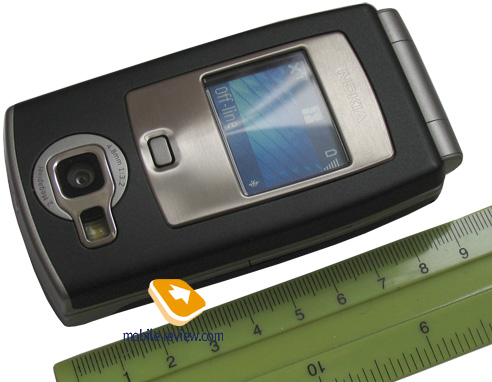
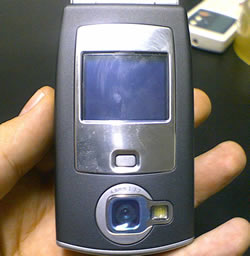
Nokia is not known for its clamshell handsets, but the company does occasionally make a foray into that world, and has done so with the N71.In fact, despite Nokia’s reluctance to flip, there is already a clamshell handset in the N range – the N91. Where that is a very chunky beast, with a camera in its own clamshell independent swivelling section, the N71 has a rather more traditional clamshell design, being made in just two pieces, and hinged at its top edge.The front screen offers just 96 x 68 pixels of viewing area and, a relatively limited range of features. It will show the handset status and the current time, and when you are playing music a button underneath the screen will pause and resume. But you can’t switch between tracks or fiddle with volume without opening the flip. Design wise Nokia doesn’t seem to have really taken the full potential of what the clamshell format offers on board. Let’s start with the overall size, shape and weight. The N71 is thicker than the popular candybar N70 - the other Nokia handset I happen to have handy as I write. With the clam closed it is almost as tall, and it is heavier. Compare for yourself: N70 53 x 109 x 22mm, 126g; N71 51 x 98 x 26mm with the flip closed, rising from 98 to a shade over 180mm tall with the flip open and 139g.When you open the flip there is room for a decent sized screen and for large, well spaced keys. What does Nokia provide? A screen which is nicely specified in terms of pixels – 240 x 320 of them – but a mere 2.4in diagonal in size. I’d have liked to see it larger. The keypad is the bigger disappointment, though. The number pad and control keys are separated by a design feature – a slightly curved indent in the casing which to my mind just consumes potentially useful space.There are several things I just don’t like about the keypad design design. The softkeys are a long way from the softmenus they map onto, and while you will get used to this it is a little disconcerting at first.The navigation key sits in the centre of a familiar group – Call, End, and those softmenu keys. It could easily be a third larger, and its raised select button feels only OK under the fingers. The whole thing needs an element of digit-precision to use effectively.
The N71, yet another handset in the N range of multimedia rich phones, is a flip (or clamshell) phone. Nokia doesn’t do these very often – the 3G N90 with the Carl Zeiss camera lens and the non 3G 6131 are the two most recent examples, but they are mere droplets in the vast ocean of Nokia handsets. So we had somewhat baited breath waiting for the N71 to land on our desk.
When we took the N71 out of its box, our first reaction was raised eyebrows. ‘Are you sure this is a clamshell?’ we asked ourselves, and exclaimed, ‘it’s huge!’ As we see it, the plus points for clamshell phones are: they are small and so ideal for tiny pockets; they look cool as they have a smooth opening mechanism and are easy to open one-handed; just as with sliders, you can control a lot of features without opening the handset; and inside there is room for a large screen and a big keyboard.
Nokia does not agree. The N71 is vast – 98.6 mm tall, 51.2 mm wide, and 25.8 thick. At almost 10cm high, it is a rival for Nokia’s solid candybar performer the N70, for example. The size matters because it means you are likely to need two hands to open the flip, and this is particularly annoying because Nokia hasn’t built any spring-loading into the mechanism. It is also irritating because when you do open the N71 what you find inside is a reasonably small screen. At 2.4 diagonal inches it is actually a pretty good size for a mobile phone screen, but it looks a bit lost in its large surround, and nowhere near fills the available space. And the chunky-fingered, who often like clamshell handsets because they afford space for a larger than usual keyboard will find rather smaller number keys than they might like inside, and a wodge of ‘dead’ space occupied by no keys at all.
While we are carping, let’s talk about build quality. Many phone manufacturers are going for new looks and new ideas. Shiny back and touch sensitivity in the LG K800 Chocolate, un-phonelike looks and controls in the LG U400, smooth lines in Sony Ericsson’s W900i. Nokia has chosen, by comparison, a rather plasticy and low quality feel for the N71. Go figure.
Back to the front for a moment (to coin a phrase). The front screen is pretty small, surrounded by a large frame of shiny silver. It isn’t all that capable. It shows the handset status and the time, and a single button beneath the screen will pause and resume music. But you can’t choose tracks using this button.
Nor can you start the main, 2 megapixel, camera, whose lens sits on the front of the clamshell case, running with the handset closed, which means you are a bit hampered when it comes to shooting quick snaps. We are quite used to seeing front screens on clamshell phones doubling as viewfinders, so not having that option here makes the N71 feel a bit dated.
Well, the music playback quality is great. You’ll need to store tracks on a miniSD card as there is only 10MB of storage built in, but you get a 128MB card with the phone to get you started. And another plus is that while the headset connector to the N71 is Nokia’s Pop-Port, you get a converter to a 3.5mm jack so you can use your own headset if you prefer it to the one Nokia provides.
We also like that infra red is built into the N71. Bluetooth is here too, of course, but we find infra red is ideal for quickly swapping files between two different handsets – much less hassle than using Bluetooth. There is no Wi-Fi, though, something we are starting to see in more and more handsets.
When making video calls using the VGA camera that sits above the screen, you can either hold the N71 in your hand with the clamshell fully open, or open it point where it clicks into a gentle lock at a suitable angle to sit the handset on a desk. It is no problem to switch from the front camera to the back one, so that the person you are calling can easily see what you are looking at rather than your own, er, ugly mug.
Nokia introduced today the Nokia E71 and Nokia E66 (compare specifications), the latest devices from the Nokia E-series optimized for e-mail. The Nokia E71 QWERTY smartphone and the Nokia E66 slider phone both support Microsoft Exchange, and were designed for people who want quick access to personal and work e-mail with the touch of a button. A Mail for Exchange mobile e-mail client comes pre-loaded with both phones, providing real-time access to e-mail, calendar, contacts and tasks.
The Nokia E71 and Nokia E66 also support e-mail accounts from more than a thousand internet service providers (ISPs) around the world, as well as Gmail, Yahoo! mail and Hotmail. Additionally, the Nokia E71 and Nokia E66 support the Nokia Intellisync Wireless e-mail solution as well as third party e-mail solutions like System Seven and Visto Mobile. Both models come with a new switch mode that allows people to quickly switch between personal and work home screens.
With a stainless steel case, etched graphics and available in two colors - grey steel and white steel - the Nokia E71 is designed for both one-handed and two-handed use. The Nokia E66 offers stainless steel accents and a sliding design, and like the Nokia E71, it includes an enhanced calendar, contacts and customizable home screen modes. The Nokia E66 also sports an orientation sensor that automatically optimizes itself for full screen viewing or silences the ringer when the device is turned over.
In addition to e-mail and personal information management, the Nokia E71 and Nokia E66 support the latest Ovi services including maps, music and media sharing. Furthermore, the feature list includes HSDPA, Wi-Fi, Assisted GPS (AGPS), Nokia Maps, a music player with support for up to 8GB memory and a 3.2-megapixel camera with autofocus.
The Nokia E71 and Nokia E66 also come equipped with a suite of enterprise grade features, including built-in encryption functionality for the device memory and the memory card. Both models also include integrated mobile VPN support.
The Nokia E71 and Nokia E66 are expected to begin shipping in Europe in July, selling for EUR 350 before applicable taxes and subsidies. Both models were announced with versions supporting AT&T Wireless' HSDPA network, so unless AT&T picks them up, they should both be available as unlocked phones in U.S. retail and Web stores later this summer.
Design:
Obviously this is subjective, but this could really be one of the sexiest damn phones we’ve seen in a very long time. We could do without the tacky pattern on the back battery cover, but we’ll let it slide this time. The entire phone is chrome and while it’s definitely a fingerprint magnet (just have your assistant wipe it down for you) it looks really sharp in person. Everything is proportionate and sort of just works well together. The middle select key actually serves as the notification light, too. So when you have a missed event, the border around the middle key will glow white until you cleared the event, or until the expiration time you set for the notification light expires. It’s a nice touch and a creative way to get rid of the annoying older-fashioned status light. Oh yeah…did we mention this thing is thin? Seriously, we don’t know how they did it. Especially with everything that’s packed in here…man, that BlackBerry Bold is just huge compared to this. Everyone is going to have to step it up after this because as of now, we can’t find one single thing Nokia sacrificed to make the device this thin and compact.
Screen:
There’s a 320×240 screen on the E71 and it looks very sharp. It’s not as bright as the N95, but it’s very clear and easy on the eyes. Screen real estate isn’t a problem at all as we find it more pleasurable to use than an N95. Pictures and video look very detailed and clean. There’s a decent amount of contrast when looking at media, and you’ll especially appreciate the screen during some heavy web browsing.
Connectivity:
The world must be changing. Remember when Nokia would hold every single feature above your head and never give you the perfect phone? Well, we’re finally getting past that. We’re not positive if there’s support for the 2100MHz band here, so for now, we’ll assume it doesn’t have it and there will be a US NAM model, and European model. In terms of the hard connectivity specs, you’ve got a quad-band GSM/GPRS/EDGE phone with 850MHz/1900MHz UMTS/HSDPA support, Wi-Fi 802.11 a,b,g, Bluetooth 2.0, and GPS. Like most recent Nokia’s, the GPS is assisted by the network, but fret not because there still is a physical GPS chip in here.
Sound:
Like the E61 and E61i before it, the E71 houses a single speaker in the upper left of the phone. It seems louder than the E61 and it’s pretty clear for ringtones and alert sounds. Music sounds fine on it, but it’s not perfect. Bass is seriously lacking and you do get a “tinny” sort of sound. It is very, very loud, though, so you can be sure that alarm is going to get your ass out of bed in the morning.
Email:
What good would an E-Series device be without email? Besides the normal POP3/IMAP supported protocols, Nokia’s Mail For Exchange comes with the device out of the box and is incredibly easy to setup. The handset supports BlackBerry Connect (though we didn’t actually try it) and we’d imagine Goodlink as well. The messaging application had a little bit of a visual makeover, and it’s for the better. Text is extremely readable and emails look great. We’d have loved to see support for HTML email, but oh well.
Keyboard:
If there had to be one negative to the E71 (relax, it’s not the end of the world) it’s going to be the keyboard. Again, not a huge deal, but if we had to pick one thing to single out it’s the keyboard and it quite possibly won’t bother you. It did annoy us, though. Think of the physical keys on the E71 the same as the E61, just a lot smaller. They’re also not as squishy which is nice, and they’re pretty easy to press once you get it down. Our issue is, again, Nokia has not learned the basic keyboard layout and we personally can’t stand it. On a normal QWERTY keyboard the letter “z” is not directly under the letter “a”. It’s either under the letter “s” or somewhere in between the two. This makes typing a royal bitch if you’re not looking directly at the keyboard and is totally unnecessary. All they had to do is stick the damn period key in front of the “z” key and all would be well. Again, this might not be a big deal to you if you’re coming from a QWERTY E-Series already, but for us hardcore freaks who bang away constantly on the keyboard, we’d like the normal layout that’s used on basically every other QWERTY phone on the planet. Fix it please, Nokia. The keys have a nice white backlighting which makes them very easy to read. Just like the other models, the actual keys don’t light up, just the letters and symbols which makes for a very clean and sexy look.
Something also interesting is the inclusion of predictive text on here. You might be thinking why you’d ever need predictive text when you’ve got a QWERTY keyboard, but it actually helps more than it gets in the way. It sort of works like how the iPhone does. If you’re typing fast and accidentally misspell a word but keep typing and hit the space bar, it will auto correct and suggest that word for you. It can also save you a good amount of typing time as it will suggest words for you when you are halfway through them and a simple press of the space bar selects the suggested word and keeps you moving.
Expandability:
There’s a microSD card slot right above the microUSB port on the handset, so you should be able to expand the memory of the phone to the largest microSD card you can find. We haven’t checked data transfer speeds to the memory card over USB yet, but we’re assuming it’s on par with the rest of the Nokias.
Call quality:
Nokia and call quality go together like ham and burger. Kool-Aid and sugar. The E71 doesn’t disappoint. We’ve had such a pleasurable experience with it that we’ve been calling people randomly just to talk on the phone. In all seriousness, it meets or exceeds what we’ve come to expect and love from Nokia. A phone that excels as a phone, as it should. It actually went toe-to-toe with our BlackBerry Curve in terms of holding onto a signal in low coverage areas. And all you BlackBerry lovers out there know that RIM makes one hell of a cell radio in those things.
Battery:
There’s a 1500mAh battery in the E71, and with a full day of heavy use like constant email, phone calls, web browsing, and all around messing with the phone, we’ve still got around 2 bars left. There should be no concern with the battery life here.
The Nokia E71 and Nokia E66 are Nokia's latest phones optimized for e-mail, and both support AT&T Wireless' HSDPA network.
Conclusion:
We’re at the end of the review, but by now, you’ve seen how impressed we are with the phone. It takes a lot to get us excited but the E71 has done it. This thing, in our opinion, is the best phone Nokia has made to date. That’s a very bold statement, we know. But this really is going to be the phone to beat by a lot of manufacturers. From the design, to the specs, to the size, the feel — it has the entire package. It’s not for everyone, though. Some people prefer a straight up phone like a flip phone, but in terms of a smartphone with a QWERTY keyboard, this takes the cake. It is just striking compared to the shit device the E61 was. It’s ok, we still love y’all that carry the E61, but this puts it to shame. One thing I personally can’t get over is the awesome dimensions of the device. It’s so perfectly thin, yet incredibly comfortable to hold and use. We just hope Nokia doesn’t wait too long to bring this to market as they need to strike now. Like right now. This second. After seeing all of the detailed shots and our impressions, how do you guys feel about the phone? Are you foaming at the mouth waiting for it or ice-grillin’ us?
The Nokia N99, is it real. Pictures are floating around the net. Blogs are talking about it, bookmarks are getting interesting reviews. Social networks, are spreading the word. Faster then wild fire, spreads a fire. The speculation is end less. The true question is. Will, this phone be on the market anytime soon? That question, has been on every nokia fans mind. The answer, is still un answered. Though, some high profile blogs have reported, that the phone is still in its building stage.Nokia is going to soon announce the launch of the next Nseries mobile phone with a 8 Megapixel camera and xenon flash which you can preview in the following image. The design is similar to the Nokia N93 mobile phone which comes with a slider and the camera can be rotated in any direction.The Nokia N93 had only a 3.2Megapixel camera but this one may have a 6 to 8 Megapixel camera and make it the best digital camera mobile phone with the highest sized image resolutions and quality.
ITS ROCKING PHONE:
Considering, the iphone has just been released. Maybe it is a good idea, the Nokia N99 stays put. What the phone offers, is still not yet answered. Though, the pictures floating around. Looks, like Nokia will be having windows mobile OS? If this is true, will this be worth buying? What version of windows will they run? Shifty sources, have claimed. That the phone, might be using a new mobile OS. Vista, which was earlyier released from microsoft. Proclaiming itself, as the next best OS out there. Another great, OS by microsoft themself. Though, vista being on a mobile phone. Will be extremely insane, and radical!
ITS FEATURE:
Another odd thing about the Nokia N99, is the keyboard. They seem, to not care about the new futuristic designs. Touch screen, surface touch, or anything related to not clicking. Instead, the phone has a “qwerty” keyboard layout. The general opinon of the mass media, consumer. They seem to be ok with it. As long as the phone carries wifi, email, gps, consumers seem to be satisfied. Speculating, at the other phones in the current market. It might be safe to say, the Nokia N99 will have a camera and mp3 system. So that you may share, send and take pictures. As well as download, your favorite song of the day.This was submitted to me today. Pretty cool looking, although not an official Nokia device... that I'm aware of.9 way front joystick button, 16GB FLASH internal memory, up to 4GB mini SD slot, 16:9 3.2" wide screen, GPS, MP3, DIVX XVID MPEG AVI video reading, WLAN WIFI, qwerty pad, 8MP camera, 3CCD 720 pixel wide 30fps video capture, etc... The real mean machine!Some of these creative minds should be working for Nokia... that Word Processor thing looks killer!!!!This is the smash feature from nokia.It is not only a cell phone but also a personal computer.
LAST THING OF NOKIA N99:
Nokia N99 Video Review - The funniest home videos are here With all the speculation on the Nokia N99, we can only whisper and type away. What we wish this phone will have. Hopefully, in the coming future, we will have more general information on the phone. Maybe even a few real phone pictures a long with some nice facts, from the one great reliable source. Nokia themselves!Photos of the new N99 Nseries phone by Nokia have surfaced online.
Introduction : The Nokia E60 is a standard candybar phone and compared to other Nokia business phones (9500 or 9300i) the E60 is somewhat smaller and also cheaper. Weight is 117 g (with Nokia Battery BL-5C) and dimensions are 115 mm x 49 mm x 16,9 mm.The E60 packs in almost every business function that exists, including a few novel ones. Naturally the basics are covered - integrated speakerphone, vibration alert, voice commands, voice recorder, email, web browser, Bluetooth wireless connectivity. Then there are some less common but valuable features - 3G, Symbian applications, Push to Talk, an attachment viewer for browsing Office documents, Wireless LAN and a memory card (plus a generous 64 Mbytes of internal memory).
Finally, there are a couple of novel features that might or might not prove useful. The first of these is the capacity to make VoIP calls via the wireless LAN connection. Making free calls is probably not top priority for the average business user, but this could still prove be a useful feature. There's also a feature that people will love or hate: Talking Caller ID. This means that the phone will speak the name of an incoming caller as part of the ringtone. Could be useful (or embarrassing!) Price £203.40 (Exc VAT)
Design :
The E60 is, to put it bluntly, a bit of a brick. Nokia calls it a "monoblock", and at 115mm by 49mm by 16.9mm and 117g, that it is. Given the Finnish company's recent experimentation with unusual phone form factors (such as the keyless 7380 and the swivel-happy 3250), it's a contrast to see a regression to the basic rectangular shape of days gone by. With its silver accents and simple silhouette, the E60 is not unattractive, but it does reflect the strictly business nature of the phone's features.
For a large phone, some of the buttons are curiously tiny. The power key on the top right is small and stealthy, and Nokia's decision to refer to the five-way directional key as a "joystick" was somewhat optimistic. Scrolling through Web pages for more than a few minutes will bring you not joy, but a sore thumb, due to the small, recessed nature of this square button.
One thing that did make us very happy was the brilliant display. The 16 million-colour screen is simply gorgeous, and makes reading Web pages and e-mail attachments very easy on the eyes. Features :
Many of the features across the Eseries have been designed to fit in easily with an existing enterprise environment, removing the hassle of setting up protocols, proxies and passwords. Particularly useful features of the E60 include the ability to connect to your company's IP-PBX system so that calls to your desk phone are automatically diverted to your mobile. This also means that you can use the E60 to perform workplace telephone functions like call transfer and voicemail forwarding.
For mobile mail, you can go the IMAP/POP3 standard route, or take the plunge into push e-mail. The Eseries phones support third party push applications including BlackBerry Connect, meaning the E60 can swiftly slot into an existing BlackBerry enterprise set-up. Key Features :
* Symbian OS v9.1, Series 60 3rd Edition * 64 MB internal memory * WLAN (WiFi) with SIP compliant VoIP client * Bluetooth 1.2, Infrared and USB support * EGSM 900, GSM 1800, GSM 1900 and WCDMA * Web browser based on WebKit * 352 x 416 pixel full colour LCD. * no Radio * no camera * 115 mm x 49 mm x 16.9 mm, 117 grams PC Connectivity * PC synchronization with Microsoft Outlook and Lotus Notes via Nokia PC Suite (available to download for free at http://europe.nokia.com/pcsuite) provides you with up-to-date personal information * The Nokia E60 can be used efficiently as a modem over local and global networks
Ease of Use * Wide, advanced high-resolution screen makes images sharper and reduces the need to scroll * Documents and applications appear with high clarity * User friendly, sleek design Compatibility * Supports leading push email clients * Organizer compatible with MS Outlook and Lotus Notes * Supports up to six Bluetooth wireless connections at the same time * Add-on memory with RS-memory cards via hot swapping capability Security * Device lock * OMA Digital Rights Management 1.0 (Forward lock, Combined Delivery, Separate Delivery, Superdistribution) * Secure Socket Layers 3.0 and Transport Layer Security (TLS) * WLAN security framework Performance :
We had no problems with connectivity -- Bluetooth devices paired instantly with the E60, and file transfer was quick and easy. E-mail transmission and attachment handling (PDF, Word and Excel documents) was also problem-free, with those wonderful wizards guiding the set-up process. We appreciated the ability to edit received documents rather than just view them.
Despite our grumblings about navigating with the joystick, we liked the way Web browsing was handled. The relatively new S60 Web browser, which is based on the same components as Apple's Safari application, allows big, complex Web pages to be displayed on small screens with few changes to design and functionality. It's a brilliant browser -- we especially liked the Page Overview function, which displays a mini screenshot of the entire page so you know which direction to move your pointer in. The phone's display rotate feature also allows you to browse in landscape mode.
Voice features all performed well; the speakerphone was nice and clear, although playback volume without headphones was a little soft. You also need to stay within a metre or two of the microphone when recording.
Battery life was very good, with the phone lasting almost a week on mid-level voice and text use. Extended internet use did bring battery life down significantly, but no more than you'd expect for a 3G smartphone.
Generally, the E60 was a pleasure to use. It may not suit heavy mobile Web users given the screen size and small joystick, but push e-mail devotees who don't want a device of PDA proportions will be happy with this model. It's not a phone that you'd slip into your board shorts when the weekend rolls around, but the focus on workday functions and corporate integration means it does everything you'd want a business phone to do.
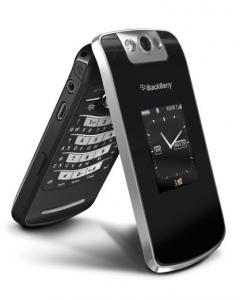
BlackBerry-maker Research In Motion (RIM) Ltd. on Wednesday unveiled its first ever flip smart phone, the BlackBerry Pearl Flip 8220.
The first flip form factor BlackBerry comes at a time when RIM is tweaking its traditionally business-only devices and continuing on its path of targeting consumers and corporate users alike by adding a host of multimedia capabilities. Adding a flip phone to its portfolio taps a new user base: flip phone fans that didn't bite at the original Pearl's candy-bar design.
Research In Motion that facing mounting competition from Apple Inc.'s iPhone, is trying to extend its success beyond business users with its first flip model. Consumers accounted for about 60 percent of new subscribers in the first quarter and now make up more than 40 percent of customers. About 75 percent of mobile phones sold in the United States are the flip kind, Balsillie said.
"The most common preference is the flip and yet it's the most unaddressed because it requires some special innovation," Balsillie said. The company created a special hinge for the Pearl that gives more room for the keyboard and trackball. The Pearl Flip will be available in the United States from Deutsche Telekom AG's T-Mobile unit.
It sports a 240x320 display, only now it folds out. The keypad still uses BlackBerry's Suretype system, which places two letters per key. But the buttons are more spacious and feel easier to use than those on earlier Pearls.
The nicest touches is that the external screen displays incoming e-mails with a brief snippet of the message so you don't have to open the phone to know what the e-mail is about. The front of the phone is jet black and looks like it will attract its fair share of fingerprints.
Moreover the quad-band phone (GSM 850/900/1800/1900; GPRS/EDGE) is set to be released through T-Mobile, though price and availability have not been set yet.
Some wonder if BlackBerry is taking a risk with this design. A lot of Pearl customers are new to RIM anyway, so they're not wedded to any design. So you give them a different design but keep the same BlackBerry experience. It provides that much more choice, and that should continue RIM's success story as it reaches out to more consumers.
Additionally, the RIM has finally got a flip phone to market, phone fashion has again moved on, with slider-phones (where the keyboard retracts) and all-screen models like the iPhone setting the trends.
A second new model, the BlackBerry Bold, maintains the brand’s traditional candy bar form factor, and does support 3G – in fact the pumped up HSDPA (aka 3G Broadband) iteration.
And where the Pearl Flip has a narrow keypad, the wide-bodied Bold sports a full QWERTY keyboard. The Bold also adds GPS support and, like the Flip, wi-fi.
Regardless of snipes against the Pearl Flip, the Canadian-based RIM steamrolls on. One in 10 phones sold in the US is now a BlackBerry, RIM says, with 5.6 million new subscribers added in the last quarter according to Gartner figures.
The BlackBerry Pearl Flip 8220 is expected to be available from several global carriers in the fall. It will first be available through T-Mobile in the U.S. Pricing has yet to be announced.
Today, Nokia introduced the compact new Nokia 3610 Fold phone. The quad band (GSM 850/900/1800/1900) handset comes with everything people need to stay in touch. The spacious keypad of the Nokia 3610 Fold makes for effortless typing of texts and messages and ensures excellent usability. The smooth back fold design gives the Nokia 3610 Fold an understated elegance and its ergonomic shape - when opened - makes for a seemingly natural alignment to the human face. With a 1.3 Mega pixel camera and 6x digital zoom, the Nokia 3610 Fold makes it easy to capture memories and share moments with others. The bright 2” screen of the Nokia 3610 Fold displays pictures, messages and web pages in up to 262K colors while the external display indicates incoming calls, messages or an analogue clock With support for optional micros cards of up to 4GB the Nokia 3610 Fold comes with ample memory for pictures, videos, music and more. The Nokia 3610 Fold is expected to start shipping in the 3rd quarter of 2008 for an estimated retail price of EUR 125 excluding taxes and subsidies. Related photos in print quality can be found at www.nokia.com/press/photos
Size: Dimensions:99.6 x 44.3 x 19.6 mm, 67 cc.Weight:97 g
Display: Type:TFT, 256K colors.Size:240 x 320 pixels, 2.0 inches,Second external TFT display (128 x 160 pixels), 1.36 inches, 256K colors.
Ring tones: Type Polyphonic (64 channels), MP3.Customization:Download.Vibration:Yes Memory: Phone book :Yes, Photo call.Call records:Yes.Card slot:microSD (Translate), up to 4GB-30 MB internal memory. Data: GPRS:Class 10 (4+1/3+2 slots), 32 - 48 kbps.HSCSD:No.EDGE:Class 32, 236 kbits.3G:No.WLAN:No.Bluetooth:Yes, v2.0.Infrared port:No.USB:Yes, v2.0 microbus.
Other features: Messaging:SMS, MMS, Email.Browser:WAP 2.0/xHTML, HTML.Games:4 + downloadable.Colors:Blue, Red, Green, Rose. Camera :1.3 MP, 1280 x 1024 pixels, video(QCIF),Java MIDP 2.0,MP3/AAC/eAAC+/WMA player,T9,Built-in.handsfree,Voice memo/commands, Stopwatch Battery: Standard battery, Li-Ion 1020 mash (BL-5C). Stand-by: Up to 457 h Talk time: Up to 4 h 38 min Software:
Software platform and user interface
Series 40
Active standby
Voice commands
FOTA (Firmware update over the air)
Personal information management (PIM): contacts, clock, calendar etc.
Advanced contacts database: multiple number and e-mail details per contact, contacts with images
Included games: - Seasweeper - City Bloxx - Snake III - Sudoku2
Hot feature:
Quadrant phone( GSM850/900/1800/1900),2 inch QVGA display,1.3 MP camera 6X digital zoom., Memory Expandable to 4GB micros card,Suppor many music playback format (mp3,wma, acc, each+)
closeAuthor: Ernest DokuName: Ernest Doku Email: ernest.doku@omio.com Site:http://blog.omio.com About: I like gadgets, loads! I like talking about them, writing about them, using them, watching other people use them though binoculars... Some would say it was an unhealthy fascination, but then I'd be all like, "Shh...," and go back to doing gadget-related things. Hit me up on Xbox Live or PSN, I'm EJStyleS. I promise to give you a good match as well as talk about things that aren't gadgets. A bit.See Authors Posts (275)
The latest brainchild of Sims creator Will Wright is said to be making it’s way onto mobile gaming’s new home on Sunday, according to a Pocket Gamer report.
Simulating the evolution of an entire universe seems like a slightly…broad topic for a video game, but the critically acclaimed designer has managed to condense it all into a title for home computers as well as the iPhone. Unfortunately, the civilisation building and interplanetary warfare aspects will be restricted to the PC and Mac versions, whilst the iPhone version concentrates upon the initial ‘cellular growth’ phase of the game. Hence the name, ‘Spore Origins’.
The game is still very impressive for a mobile phone title, and speaking at a London launch event Wright urged fans to focus on the positive points of this title: “It’s got beautiful graphics, good music and it uses the tilting controls. But we may take other aspects of Spore and bring them to the iPhone later.”
Sweet words to placate fans of mobile gaming, or an admission of more Spore content on its way to the iPhone? Well, it’s far more likely to be success in terms of sales more than anything else which determines sequels, so we’ll enjoy the first one for now…


 The bad: The AT&T 8525 is on the heavier side and the navigation array is a bit cramped. The smart phone is also pricey.